Barcode clothing label
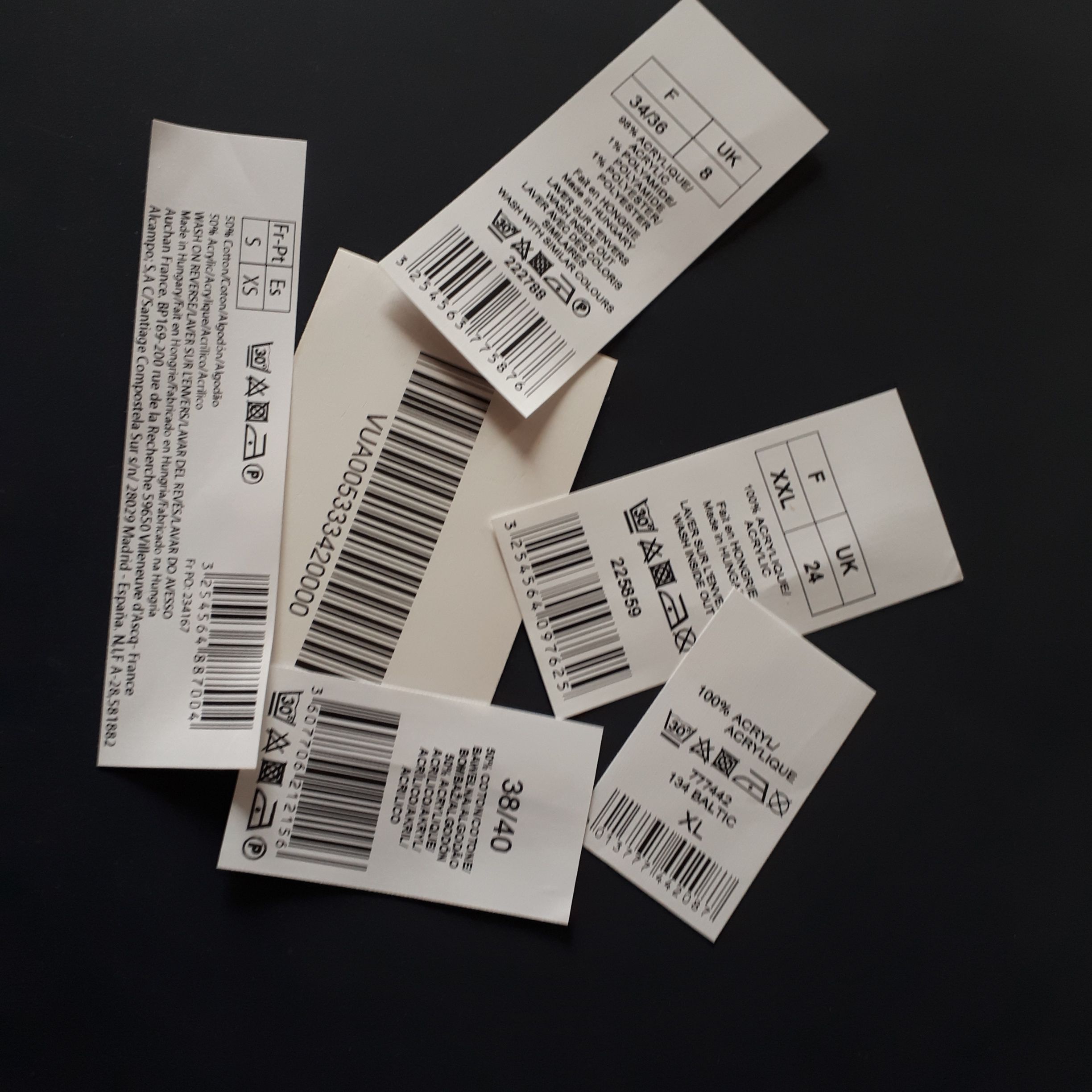
Barcodes have been in use longer than QR codes. Both can be optically read by machines, including mobile phones, and are suitable for identification due to their uniqueness.
There are several types of barcodes, with EAN-13 being the most common in retail.
Typically, the last digit of a barcode is a check digit calculated from the preceding digits according to a specific algorithm.
Barcode label
Why are barcodes so prevalent today?
Why is it advisable to use barcode labels on textile products?
Reasons for popularity:
Increased work efficiency: Scanning a barcode label takes very little time, but it can shorten the time of many workflows.
Reduced error factor: The possibility of errors during manual product identification can be eliminated by machine scanning.
Easy applicability: They can now be read with a wide variety of devices, even a mobile phone.
Cost-effectiveness
Fast production
The barcode itself contains only lines, optionally numbers and letters. The data behind it is in a computer database. The barcode is linked to the database during scanning.
The inclusion of numbers and letters below the barcodes is optional.
What data is a barcode label most often used to identify?
- Article number
- Country of origin
- Production number
In which areas are barcode labels most widespread for textile products?
- Retail and wholesale
- Production
- Warehousing
- Logistics
- Clothing rental
- Costume wardrobe
In terms of placement, the following types of barcode labels are used for textile products:
- Sew-in label
- Cardboard hang tag
- Self-adhesive pouch label on the product packaging
We provide FREE graphic design for any of the above types of clothing labels for our customers.
The inclusion of numbered barcodes on clothing labels can also be arranged.
Consumer protection law does not mandate their use, therefore barcodes are not among the mandatory content elements of a clothing label, however, their use is advisable for the reasons already mentioned above. They are very often used in numbered form.
Egydimenziós vonalkódok (1D):
- EAN-13: This is the most common in retail. The 13 indicates the number of digits it contains. The first two to three digits refer to the country of origin. Mostly 4-5 digits identify the registered industrial manufacturing company. The last digit of the barcode is a check digit that can be generated by a mathematical algorithm determined from the other digits.
- EAN-8: A simplified version of the EAN-13 barcode label. It appears on products where it is sufficient to use fewer digits, and where the EAN-13 does not fit on the product due to its small size.
- CODE-39: A barcode type most commonly used in industry. It is most widespread in the automotive and electronics industries. Contains a maximum of 43 characters.
- CODE-128: A standardized version of UCC/EAN-128. It is suitable for identifying a wide variety of data. It is most often used in the field of shipping.
Two-dimensional barcodes (2D):
A one-dimensional barcode contains data only horizontally, while a two-dimensional barcode contains data both horizontally and vertically.
As a result, a two-dimensional barcode label is capable of storing much more data in a smaller area.
Their high data potential also allows the storage of secret data, if required.
- DataMatrix: It is mostly used to identify components, taking advantage of its property of being able to store a lot of data in a small area.
- QR code: A square barcode with a small square in 3 corners that guides the scanner to read it. A wide variety of information can be behind a QR code: website, image, data or even music.
We offer FREE graphic design for any barcode label production ordered from us.
Contact us with confidence if you are looking for a high-quality and reliable solution for barcode label production!