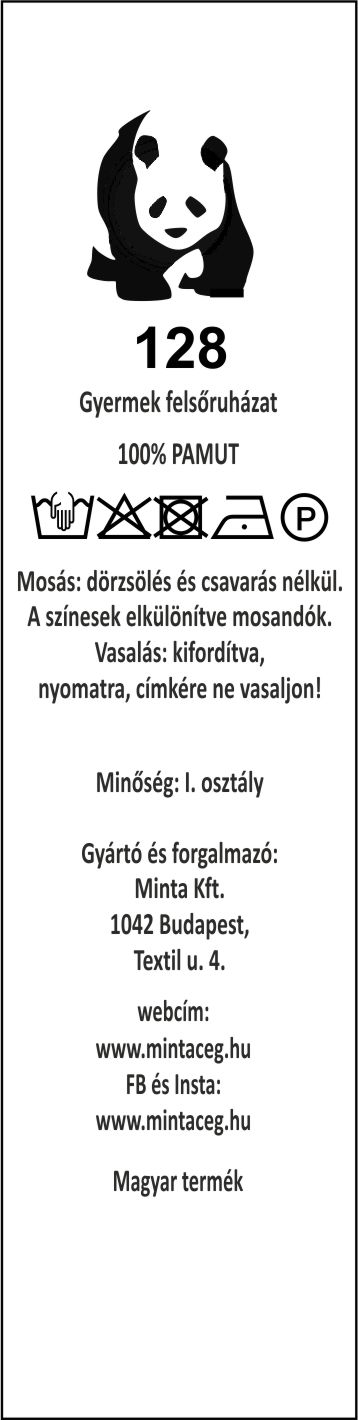
What should be on the clothing label?
It's a general requirement that products sold to end-users must be labeled. This, of course, applies to textile products as well.
Labeling of textile products marketed in Hungary must comply with the relevant regulation of the European Union and the requirements of the Hungarian Consumer Protection Act.
In addition to the EU regulations, some member states apply further mandatory content to clothing labels. For example, France requires distributors and manufacturers to use specific pictograms, as required by decree, for the recycling of clothing products and their packaging.
It is generally required that the content of the clothing label be indicated in the language of each state where the product is marketed.
Below, we deal with the mandatory content elements to be indicated on the labels of textile products marketed in Hungary.
The information that must be included on clothing labels is:
- Material composition
If the product consists of several materials, it is necessary to indicate all material components in decreasing percentage order. In Hungary, the use of abbreviations for material compositions is not accepted; materials must be written out in full.
If the product also has a lining, it is advisable to indicate its material composition as well.
Textile care symbols, i.e. care instructions
These are discussed in detail on the previous page of our website.
It is mandatory to indicate 5 signs in the following, fixed order:
- washing (water symbol in tub)
- bleaching (triangle)
- drying (square)
- ironing (iron)
- dry cleaning (circle)In addition to the above, it is possible to indicate further textile care symbols, not mandatory. (e.g. prohibition of twisting)
- Size (according to the nature of the product) (can also be indicated on a separate label)
- Exact name of the goods (this cannot be replaced by a trademark or brand name)
- Name and address of the manufacturer or distributor in an identifiable manner
- Country of origin, if not from the European Union
- Quality class
- Other information regarding hazards (e.g. not suitable for children under 3 years of age, keep away from fire)
In addition to the above, it is of course possible to include other data on clothing labels. These provide additional information for customers and can be useful for marketing purposes or product identification.
These include, without limitation:
- logo (this can be important for marketing reasons)
- further contact details of the manufacturer or distributor (e.g. website address, social media contacts, even in QR form)
- other pictograms relating to the handling of the textile product in addition to the mandatory textile care symbols (e.g. if the dryer cannot be used, the sign of drying lying down or drip-drying)
- textual indication of textile care symbols (This is also customary in as many languages as the material composition is indicated on the label.)
- inclusion of several size parameters (e.g. on work clothes, height, hip or waist size are often also shown on a figure showing a human figure, in addition to the general size designation (e.g. 38))
- barcode or QR code providing unique identification (e.g. in trade)
Fixing of clothing labels
The label must be placed on the packaging of the textile product or attached to the product.
It is also possible to use a so-called accompanying label made of cardboard. In this case, the mandatory content described above can also be included on it, but the cardboard label must also be properly attached to the product, e.g. by shooting with thread.
It is not appropriate to attach the clothing label to the garment by gluing, as it can be easily removed from there.